
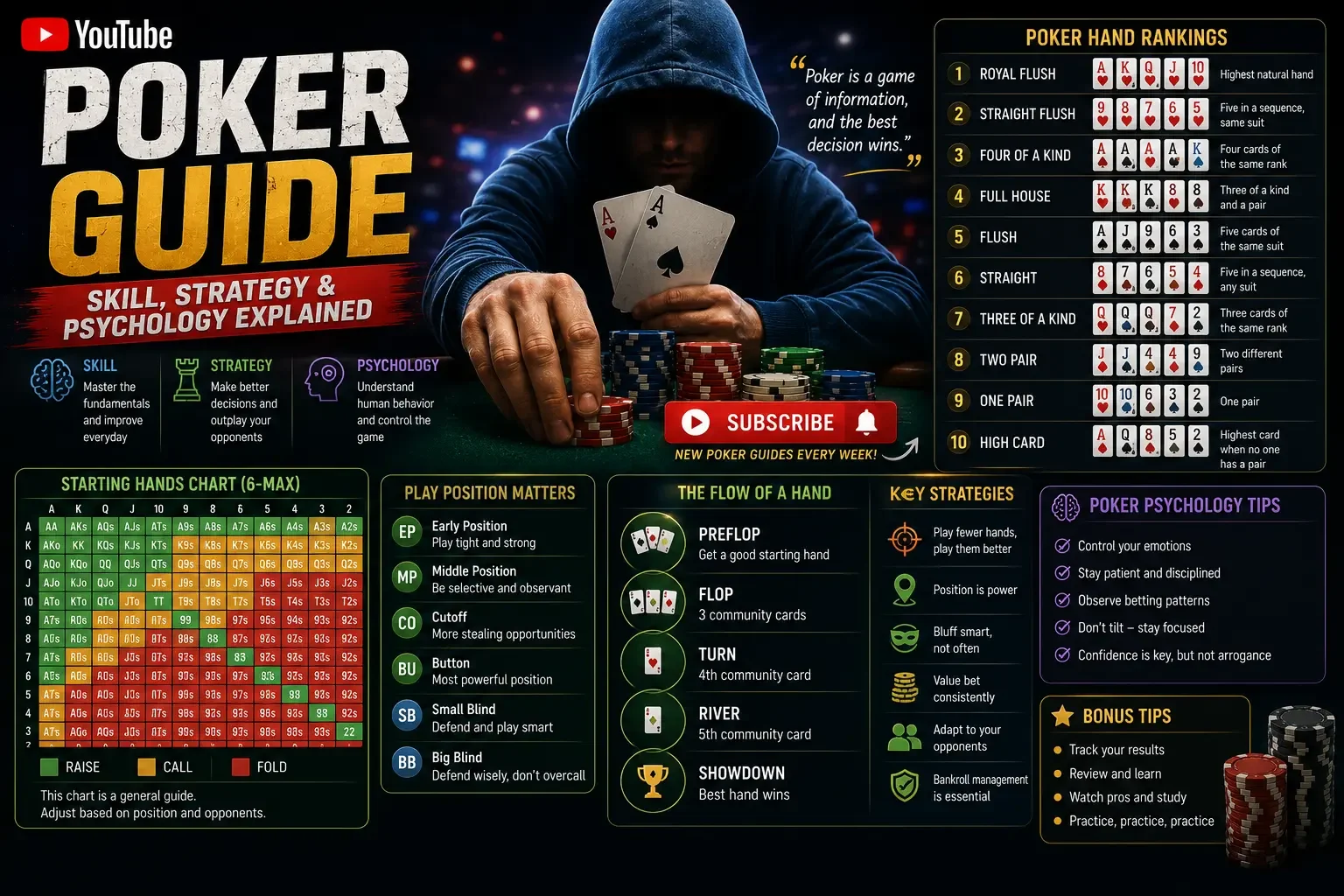
Poker is not merely a card game; it is a captivating cultural phenomenon, a blend of strategy, psychology, and chance that has enthralled players for centuries. Yet this characterization, while accurate, understates what makes poker fundamentally different from other games. Poker isn’t simply a game with both skill and luck elements—it is a model for decision-making under conditions that mirror real human existence: incomplete information, uncertainty, emotional pressure, and the perpetual need to calculate risk against reward with imperfect data goexch9
The Origins: From Mystery to Mathematics
The precise beginnings of poker are enshrouded in both mystery and intrigue, with historians tracing its lineage to a confluence of ancient and early modern card games. Many scholars suggest that poker descends from the Persian game As Nas, played in the 16th century, which featured betting, hand rankings, and strategic elements strikingly similar to contemporary poker. Yet poker as Americans recognize it emerged in a specific cultural moment. The game emerged out of the French cultural milieu of New Orleans during the decades after the Louisiana Purchase of 1803.
This origin is significant. Poker didn’t arise from formal mathematical theory or deliberate design. It evolved organically from existing card games, modified by players according to their own intuitions and preferences. Like most card games, poker evolved, incorporating elements from other games, modifying them according to the habits and whims of players. This evolutionary process—rather than design—explains poker’s peculiar genius: it emerged as the natural expression of how humans intuitively structure games that reward both luck and skill simultaneously.goexch9 login
The Dual Nature: Why Poker Resists Simple Categorization
Why has poker so consistently inveigled the American imagination? A perfect amalgam of skill and luck, the game has the virtues of simplicity and versatility. You can learn it in ten minutes and spend a lifetime acquiring proficiency. This quotation captures poker’s essential paradox. Unlike chess (pure skill), or roulette (pure luck), poker occupies an unstable middle ground—one that perfectly mirrors how humans actually make decisions in the real world. goexch9 hindi tutorial
Unlike many purely luck-based gambling games, poker requires players to master intuition, probability, and the art of deception. These three competencies are irreducible. A player lacking mathematical understanding of odds will fail. But a player with perfect mathematical knowledge and no psychological insight into opponent behavior will also fail. And a player with neither mathematics nor psychology, relying purely on intuition, will eventually be overwhelmed by skilled opponents. Poker demands integration of these capabilities goexch9 exchange api
Another definition of skill is the extent to which players can improve, and it has been shown that poker does indeed possess a significant amount of this feature. This measurable improvability distinguishes poker from pure games of chance. A roulette player’s results improve only through variance. A poker player’s results improve through learning, practice, and systematic adjustment of strategy. Yet the pace at which this improvement manifests depends on how many hands they play—because short-term variance masks long-term skill. goexch9 market update
Psychology: The Hidden Architecture
While the mathematical elements of poker are well-understood, the psychological dimensions define why the game endures. Poker’s soul lies in its psychological warfare. Its allure lies in the delicate balance of chance and skill, where raw intuition and cold calculation often collide in a high-stakes psychological dance. goexch9 new id 2026
This psychological element operates at multiple levels. First, players must read their opponents—identifying patterns in betting behavior, recognizing tells, and adjusting strategy based on personality profiles. Second, players must manage their own psychology—controlling emotional reactions, resisting the temptation to play marginal hands after losses, and maintaining discipline over hundreds of repetitions. Third, players must engage in meta-psychology—imagining what opponents believe they themselves are thinking, then adjusting strategy based on those imagined beliefs.goexch9 same day withdra
Tilting, in the narratives, was often instigated by dissociative feelings (‘unreality’, disbelief) following a significant monetary loss. Thereafter, moral indignation was experienced, followed by chasing behaviour, in an attempt to restore a ‘fair balance’ between wins and losses. This research captures a phenomenon every poker player experiences: the emotional instability that follows bad luck. A hand played perfectly can lose through no fault of the player’s own. Accepting this—intellectually understanding that individual hands don’t define skill, only long-term patterns do—requires psychological maturity.goexch9 agent number
It was also observed that experienced players, as compared to inexperienced ones, exhibited in their narratives a more mature disposition towards encountering ‘bad luck’, and losing in general. This distinction is crucial. Poker separates not merely skilled from unskilled players, but emotionally developed from emotionally underdeveloped ones. The game literally rewards emotional intelligence—the ability to remain rational when variance produces frustrating outcomes.goexch9 t20 cricket
The Cultural Metaphor: Why Poker Mirrors Life
Poker’s cultural footprint is vast. It symbolizes the thrill of risk-taking, the complexity of human interaction, and the pursuit of mastery over chance. This symbolic power arises because poker, structurally, mirrors the human condition more accurately than most explicit philosophies.
In poker, decisions are made with incomplete information. You never know your opponent’s exact hand. You never know what cards remain in the deck. You must calculate probabilities, assess behaviors, and make commitments based on educated guesses. This mirrors every significant human decision. You never know the full consequences of choosing a career, ending a relationship, moving to a new city, or investing your savings. Yet you must act. Poker teaches, through repeated practice over thousands of hands, how to make rational decisions despite uncertainty. goexch9 upi
Players must make calculated decisions based on incomplete information, which echoes the realities of many aspects of life. This skill set enhances not only playing proficiency but also cultivates critical thinking and emotional resilience. This educational aspect of poker—that it develops transferable life skills—explains why serious players often report that the game transformed their thinking about probability, risk, and decision-making across all domains payout goexch9 vip
Modern Poker: The Solver Revolution
Contemporary poker has undergone a fundamental transformation. The landscape of poker education has changed dramatically. The true best poker strategy books today are not the most famous ones – they are the ones aligned with the solver era. Solvers—computer programs that calculate Game Theory Optimal (GTO) strategies—have introduced mathematical precision to what was previously an intuitive art account goexch9 live game
Yet this doesn’t eliminate poker’s essence. Solvers calculate theoretically balanced strategies, but: – Most low and mid-stakes games are not GTO environments. – Exploitative adjustments often outperform pure balance. The solvers provide a theoretical baseline, but successful modern poker still requires the ability to deviate from that baseline based on specific opponents. A solver produces balanced, unexploitable play. A world-class player produces slightly exploitable play that exploits opponents more than it gets exploited.goexch9 fast payout
Strategy in online poker 2026 is no longer about secret tricks or aggressive flair. It is about combining a solver-grounded baseline with disciplined exploitation, sound bankroll structure, and the psychological consistency to execute correctly across thousands of hands. Modern poker success requires integration: mathematical knowledge (from solvers), exploitative game-reading (psychological), bankroll discipline (financial psychology), and emotional resilience (personal psychology).
The Skill vs. Luck Debate: Now Resolved
For decades, debate surrounded whether poker is fundamentally a game of skill or luck—relevant because many legal jurisdictions classify games differently based on this distinction. A few articles have defined skill in terms of the variance in results among different players, with the idea that players should perform more similarly if a game is mostly based on luck, but their results might differ more substantially if the game is based on skill.
The empirical answer is now clear: poker is fundamentally a skill game with luck elements, not a luck game with skill elements. The variance in outcomes between expert and novice players far exceeds what random distribution would predict. The same players consistently dominate tournaments and cash games across decades. Yet individual hands remain partially luck-determined—making the game accessible to everyone while rewarding consistent long-term excellence. goexch9 high volume
Why Poker Persists While Other Games Fade
To the analytical, it’s about math; to the social, it’s pure psychology; to the acquisitive, it promises gain. To all players, it offers the absorbing prospect of staking something, whether a few pennies or a fortune, and waiting giddily for the cards to decide your fate. This passage crystallizes why poker endures while fad games rise and disappear: poker offers different rewards to different personalities. The mathematician finds endless puzzles in calculating equity. The psychologist finds infinite complexity in reading opponents. The trader finds risk management practice. The entrepreneur finds a laboratory for decision-making under uncertainty.
Poker is simultaneously:
- A mathematical competition
- A psychological duel
- A financial modeling exercise
- A test of emotional resilience
- A metaphor for life decision-making
- Entertainment
- A profession
- A meditation on human nature
Few games accommodate this much diversity of purpose within a single structure.
The Fundamental Question: Does Poker Create Skill, or Select for It?
A final philosophical question: Does poker develop the skills required to excel at it, or does it merely select for people who already possess those skills? The answer, empirically, is both. Most players fail because they approach poker as entertainment. Winning players treat it as a long-term investment project. This suggests selection—people disposed toward systematic analysis and long-term thinking naturally gravitate to serious poker and excel.
Yet measurable improvement occurs within individuals who commit to deliberate practice. Another critical factor that separates long-term winners from break-even players is adaptability. The poker ecosystem is constantly evolving strategies that worked five years ago are no longer sufficient today. This requirement for continuous adaptation—updating strategies as the competitive environment evolves develops intellectual flexibility and growth mindset.goexch9 safe site
Conclusion: The Eternal Game
Poker endures because it is, structurally, an accurate model of how humans must actually live: make decisions with incomplete information, manage emotional responses to variance, integrate multiple forms of knowledge, and continuously adapt to changing conditions. No other game so precisely mirrors this reality. Poker’s popularity surged in the 20th century, especially after World War II, with the establishment of major tournaments like the World Series of Poker (WSOP).goexch9 fancy bet
From that point forward, poker moved from parlor game to cultural institution—a space where the mechanics of human decision-making, under realistic conditions of uncertainty, are laid bare and practiced obsessively by millions. In this sense, poker is less a game than a practical philosophy—one that teaches, through lived experience rather than abstract principles, how to think rationally while accepting uncertainty, how to manage risk intelligently, and how to maintain emotional equilibrium while attempting to gain advantage in a fundamentally unpredictable domain.